How to dig deeper into your state's anti-trans bills
What journalists can learn from analyzing anti-trans bills in "sanctuary states”
Looking for our community newsletter? You can subscribe to one, the other, or both by adjusting your Ghost subscription settings.
As anti-trans policies continue to spread across the United States — from the federal government’s counterterrorism strategy to the outlawing of access to healthcare — 18 states plus Washington, D.C., have some form of “shield” policy in place protecting trans rights and safety. One of only two “sanctuary states” in the Midwest, Illinois has especially been touted as a safe-haven for trans Americans by politicians and advocates. What appears to be legislative support, however, is a more complex reality.
Since 2020, the number of bills introduced in the Illinois legislature targeting civil rights and public safety for trans people has dramatically increased — as has the severity of the bills’ language. While none of them have passed into law, including the more than 20 anti-trans proposals from 2025, such an analysis forecasts the tenuousness of trans safety.
Ahead of the 2026 midterm elections, which will serve as the first test of a new strategy to limit trans rights through popular vote, this case study and the resources below offer strategies and considerations for political reporters and others covering the continued policy assault on trans Americans.
TABLE OF CONTENTS
- Overview
- What we learned about these bills
- The regional context
- Reporting questions to guide your coverage
Overview
2025 marked the sixth consecutive year of record-breaking amounts of anti-trans legislation nationally, and 2026 could match or exceed this precedent. As states around Illinois continue to limit the freedoms of trans people, the Prairie State is an outlier as a “sanctuary state,” with explicit policies protecting trans Illinoisans’ civil rights, healthcare, and access to public restrooms, such as the Patient and Provider Protections Act and HB0009 of 2021.
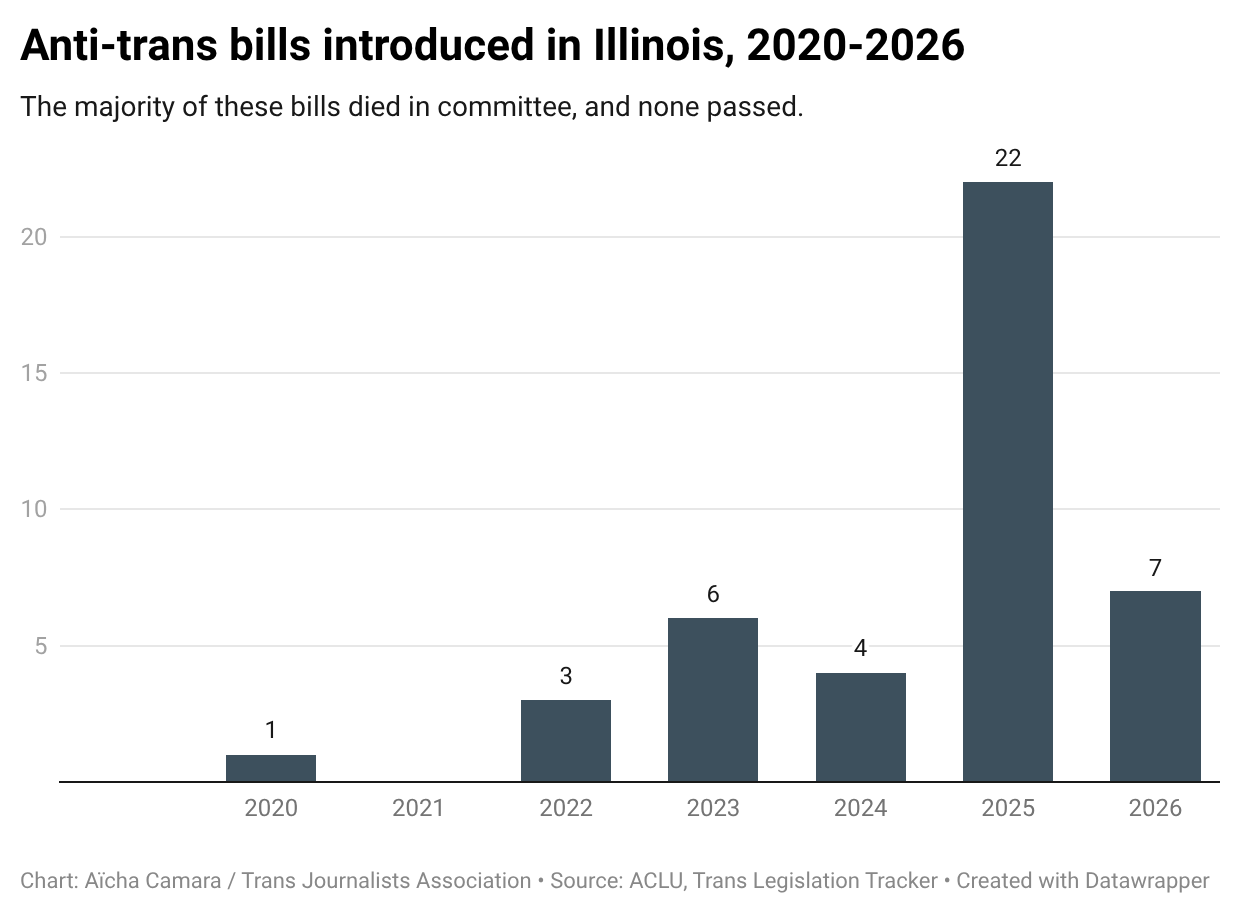
However, legislative support for transgender Americans does not always translate to a safer public, social, or educational environment. A review of existing repositories for trans legislation highlights a rise in the number of proposed bills and an increase in the severity of their language targeting trans communities in the state.
Since 2020, five Republican state legislators (Representatives Andrew Chesney, David Friess, Tom Weber, Adam Niemerg, and Chris Miller) have proposed the majority of anti-trans bills, using the same or similar terminology in bill texts as in other states. In 2025 alone, those same legislators — many of whom are also prominent members of the Illinois Freedom Caucus, a far-right legislative group known for its ties to Trumpism and other anti-trans efforts — were among a cohort who authored 22 bills targeting civil rights and public safety for trans Americans.
Moreover, from 2020 through 2026 so far, language in these bills has become increasingly extreme, and proposed penalties have grown harsher, with some of the proposals gaining larger numbers of co-sponsors with time.
None of these bills, which primarily aimed at restricting youth access to sports, the availability of healthcare, and bathroom usage, have become laws. Yet still, Illinois is among the top 10 states in the U.S. where legislators considered anti-trans bills in 2026, according to Trans Legislation Tracker.
Through an analysis, we sought to answer the questions:
- What type of anti-trans legislation are Illinois lawmakers proposing?
- How far do these proposed bills actually advance?
- What newsworthy information can we learn about the politicians and entities supporting these bills?
Within this analysis, we define anti-trans bills as legislation that directly affects transgender youth and adult access to healthcare, education, sports, and identity document changes. Additionally, this definition includes performance and drag bans, laws erasing LGBTQ+ existence from education, and vague laws, such as flag bans, historically used to limit LGBTQ+ freedoms.
What we learned about these bills
In 2020, Darren Bailey, then-State Representative and now-Senator, currently running for Illinois governor, proposed an amendment to the Unified Code of Corrections that would force institutions and prisons to house incarcerated individuals by what he described as their "biological sex," regardless of their genders. This bill quickly died in the Rules committee and was the only anti-trans bill introduced in 2020.
Since then until now, the number of bills introduced that target trans people has skyrocketed. Of the 43 bills introduced during that timeframe, more than half were proposed in 2025 alone. While the amount of anti-trans legislation drastically increased, many followed the same pattern: introduction, followed by an eventual death in a committee.
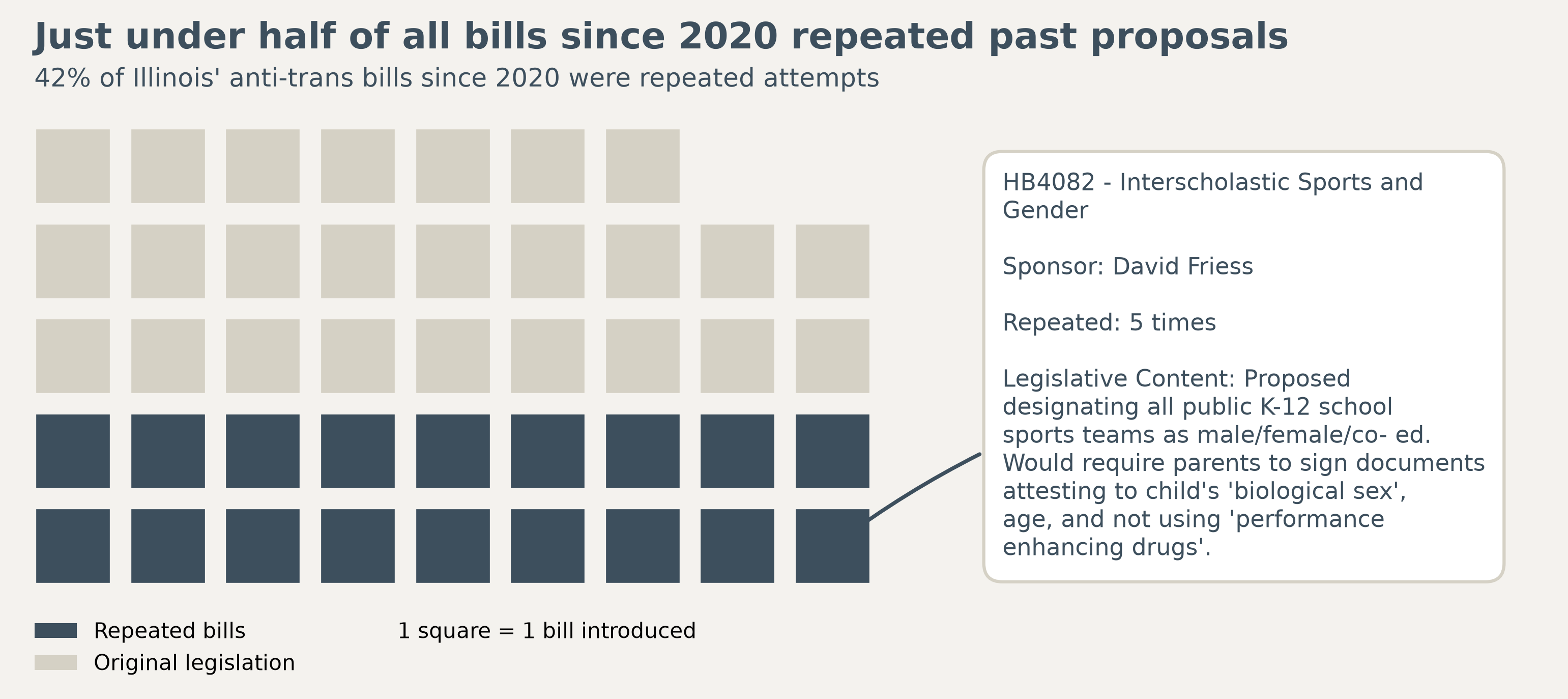
Year over year, the proposed bills often contained similar wording. Of all anti-trans legislation proposed, 42% were nearly identical bills to prior proposals.
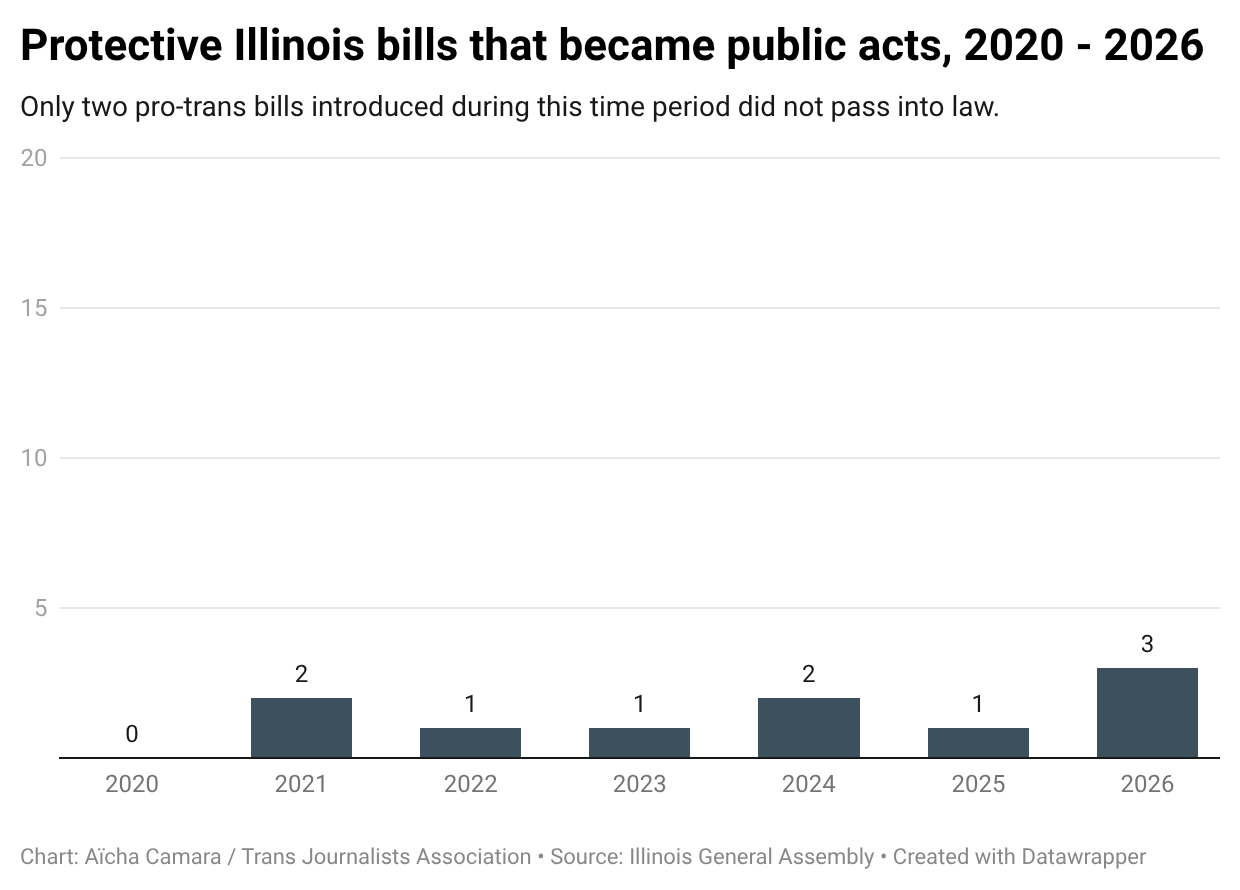
During the same time period, lawmakers signed 10 bills solidifying trans Illinoisans’ access to gender affirming care, civil rights, and queer existence.
The regional context
Within the Midwest, Minnesota is the only other state with comprehensive protective laws for their trans citizens. In 2023, Minnesota enacted HF146, a healthcare “shield” law that protects patients seeking Minnesota-based trans-affirming and gender-affirming health care (whether a resident or out of state), their families, and their medical providers from discriminatory civil or criminal charges. Advocates, however, are currently tracking 46 bills within the state tagged as targeting trans rights and protections.
In other midwestern states — Indiana, Iowa, Missouri, Michigan, Ohio, Kansas, and South Dakota — politicians passed at least one anti-trans bill in 2026.
North Dakota has yet to pass anti-trans legislation this year, despite passing multiple of these bills in 2025. In Wisconsin, a historic swing state that is currently Republican-dominated in both houses, seven anti-trans bills made it to the governor's desk before winter 2026. Democrat Gov. Tony Evers vetoed each one.
Key reporting questions for covering legislative proposals
Below are questions to help guide journalists in their own reporting to document legislative efforts to cut civil rights for trans and nonbinary residents.
- What kind of anti- or pro-trans legislation is being proposed in your state? How far do those bills advance? Who sponsors the bills? Who are the co-sponsors?
- Why did the lead author propose the bill, and how do they expect to garner enough support to pass it? If passage is highly unlikely, what does the lead author hope to achieve instead? Are there any newsworthy or surprising co-sponsors, supporters, or opponents? If a bill has died, what kept it from progressing? Did it die in committee? Was it vetoed?
- Consider which party controls your state legislature. How does that inform broader patterns in bill introduction, sponsorship, and passage, as well as the content and partisan language in the bills?
- If there is a divided government, how will the dynamics between state legislative chambers — or between the legislature and the governor — inform what gets passed and how?
- Read through the text of proposed and passed legislation.
- Are the same bills introduced in multiple legislative sessions?
- Is the same legislator or group of legislators introducing these bills?
- Is the language the same, similar, or different? What stays the same and what changes?
- How is your state protective of its trans residents, if at all? What type of protective legislation has been passed at the state level, county, or municipal level?
- Are there policymaking procedures in your state that may make it possible to pass trans-related legislation as part of unrelated bills? How does trans-related language appear in, for example, spending bills or other vehicles?
- After these laws are passed, how are they enforced — or not?
Methodology
We analyzed existing repositories for trans legislation: Trans Legislation Tracker and the American Civil Liberties Union’s dataset Mapping Attacks on LGBTQ Rights in U.S. State Legislatures.
Combined with the Illinois General Assembly website and LegiScan, we collected each piece of legislation manually. We generally defaulted to the Trans Legislation Tracker’s bill classification; however, we read and confirmed each label while sourcing critical information, such as sponsor name and party, directly from the Illinois legislature’s website into a centralized dataset. The resulting dataset contained the following key information:
- Bill Name
- Bill Classification
- Grouped bills into key rights categories commonly attacked, such as Healthcare, Bathroom Access, Sports, Civil Rights, Education, Performance, and Other, for bills that fall outside of these categories
- Anti/Pro Trans
- Following the key classifications set by the ACLU and Trans Legislation Tracker, we considered anti-trans bills as legislation either explicitly restricted trans rights (such as laws that ban youth access to puberty blockers) implicitly restricted trans rights (such as laws that limit the kinds of flags flown at public schools)
- Sponsor Name/Party
- Introduction Year
- Bill PDF
Note that this analysis solely tracked bills introduced each session, not overall active bills within a session. Inactive bills that roll over to another session were not counted after their first session within this analysis. Given that all the anti-trans bills introduced since 2020 in Illinois failed to reach the governor’s desk, we chose to track bills by the year each was introduced rather than by its active/inactive status. This allowed this analysis to focus on the sheer volume of legislation introduced rather than on the legislation’s progression through the House or Senate.
To compare the terminology within bills, we used Python’s difflib package, a tool used for comparing sequences of text to find the “diffs” or a report on the differences between the two texts.
Utilizing SequenceMatcher, a matching algorithm within difflib, we compared each bill’s text (extracted from the Bill PDF). Using a built-in similarity algorithm which returns a ratio between 0 and 1, with values closer to 1 showing that the texts are more similar, we chose a similarity threshold of 75%. This threshold allowed for key differences within bill name/introduction year and grouped bills by classification (Healthcare, Sports, Education, etc.) to locate repeated bills targeting specific rights.
We manually confirmed the similarities within each group of bills, locating the instances of identical bills v.s. increasing scope. Given the dataset's smaller size, difflib suited this analysis. However, if the project expanded to include other states or a nationwide analysis of legislation, we would swap this tool out for RapidFuzz, a scalable algorithm more suited for analyses of larger quantities of text.
Additionally, we tested Natural Language Processing (NLP) techniques to identify common rhetoric and classify the bills. However, these techniques skewed the data towards the legislation targeting sports, resulting in a biased output. That output was unusable for this analysis because NLP can develop a “majority bias” or overprediction of one classification above others.
This reporting and analysis was done by Aïcha Camara, a fellow in the 2026 TJA Reporting Fellowship cohort. It was collaboratively edited by K Petrin, C.D. Davidson-Hiers, and Tre'vell Anderson, and fact-checked by Vesper Henry.